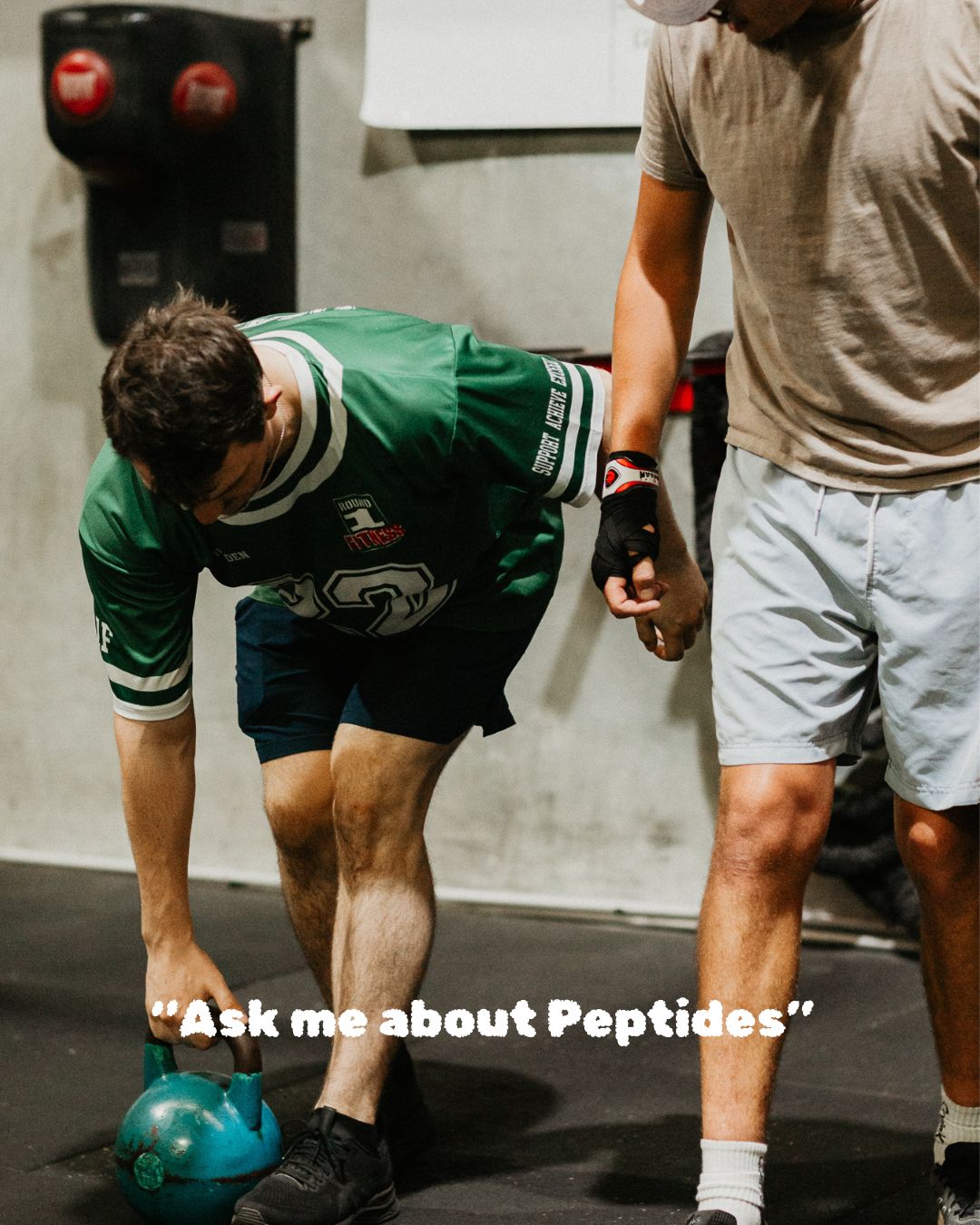
Ask Me About Peptides
ASK ME ABOUT PEPTIDES
A couple of weeks ago I was wandering around HYROX Perth and noticed a few people wearing shirts with “ASK ME ABOUT PEPTIDES” written across the back. Now, peptides cover an enormous range of things. Insulin is a peptide hormone, and there are plenty of peptide-based medicines that have been studied, approved and legitimately prescribed every day. But I'm pretty sure these guys weren't offering to have a chat about insulin.
They were talking about the rapidly growing world of synthetic peptides being promoted for recovery, injury healing, muscle growth, fat loss, anti-ageing and athletic performance. BPC-157, TB-500, CJC-1295, ipamorelin and MOTS-C might still sound like things you'd find written on the side of a drum in a laboratory, but increasingly they're being discussed in gyms, on podcasts and across social media as if they're simply another part of the modern training toolkit. Creatine, protein powder, electrolytes…and now peptides.
Post event I have been doing some reading - research and opinion pieces - and importantly listened to an episode of the Excellence, Actually podcast called “Peptides 101: Evaluating Hype, Risk, and Reward.” What I liked about the discussion was that it wasn't simply a case of saying peptides are bad and everyone using them is an idiot. That's too easy and, more importantly, probably not particularly helpful. Instead, the conversation was really about how we should evaluate something new when the marketing, excitement and anecdotal evidence are running significantly faster than the science.
The framework they used was wonderfully simple: does it work, is it safe, and what are the costs or trade-offs? Those seem like pretty reasonable questions to ask before we start injecting something into ourselves, but the more I thought about those shirts at HYROX, the more I wondered whether fitness culture has become remarkably good at skipping the questions and heading straight for the answer.
Because the current sales pitch around synthetic peptides reads almost like someone asked a bunch of members at Round 1 Fitness to write down everything they wished their body did better. Depending on the particular peptide being promoted, you'll hear claims around faster recovery, tendon and ligament healing, increased muscle growth, fat loss, reduced inflammation, improved sleep, increased growth hormone, anti-ageing and improved athletic performance. The TGA has specifically warned about unapproved peptide products being promoted in Australia with claims around weight loss, muscle growth, anti-ageing and improved cognitive and athletic performance.
It's not particularly difficult to understand why people are interested. If you're 45, your shoulder hurts, your Achilles has been annoying you for six months, you'd like to lose five kilos and somebody tells you there's something that might help you recover faster AND build muscle, I'm listening too. The problem isn't that the claims aren't appealing. The question is whether the evidence behind them is anywhere near as impressive as the sales pitch.
BPC-157 is probably the poster child for the whole peptide movement. It's commonly promoted for soft-tissue repair and recovery, particularly for tendon, ligament and muscle injuries, and has picked up the extremely convenient nickname of the “Wolverine peptide.” There are biological reasons why researchers have been interested in it, and preclinical research has explored potentially interesting effects on tissue repair and various biological pathways. That's worth investigating, and dismissing all of that research simply because BPC-157 has become fashionable would be every bit as silly as accepting all of the marketing around it.
The problem is the enormous distance between interesting and proven. Sport Integrity Australia describes BPC-157 as an experimental peptide that is not approved for human use and notes that it is nevertheless marketed online for anti-ageing and recovery from musculoskeletal injuries. Somewhere along the way we've moved from researchers saying, “This mechanism is interesting and deserves further investigation,” to somebody at the gym telling you, “This will fix your dodgy shoulder.”
Of course, there are plenty of people who swear that it works, and maybe for some of those people it did. This is where things become messy. If someone has been struggling with an Achilles injury for nine months, takes BPC-157 and six weeks later their Achilles feels better, they're probably going to tell you that BPC-157 fixed their Achilles. Perhaps it did help. Perhaps the rehabilitation finally accumulated enough load, their training volume changed, the inflammation settled, another six weeks of healing simply passed, or their expectations changed their perception of the injury. Or perhaps BPC-157 genuinely accelerated the healing process.
That's exactly why we do controlled human research. Individual experiences aren't worthless, but human beings are absolutely terrible at determining cause and effect from our own experiences. “I took it and I got better” is interesting information. It isn't the same thing as demonstrating that a treatment works.
Safety becomes an even more complicated question. I've heard variations of “there's no evidence that it's dangerous,” which sounds reassuring until you think about what is actually being said. If something hasn't been adequately studied in humans, a lack of documented long-term harm isn't proof of safety. It can just as easily represent an absence of information.
In Australia this has already moved beyond a theoretical discussion. The TGA and Australia's Chief Medical Officer issued a joint warning this year about the increasing availability and use of unapproved peptides after reports and hospitalisation data identified serious adverse effects associated with unapproved peptide products, including liver damage, severe allergic reactions and inflammatory complications requiring medical treatment. That doesn't mean every person using a peptide is going to become sick, but it does mean that “nobody has proved this is dangerous” isn't a particularly sensible safety standard.
There's also another risk that is almost completely separate from whether something like BPC-157 eventually proves to be an effective drug: how do you actually know what's in the vial?
This is one of the problems with buying something through what is effectively a grey market. You order BPC-157 and a vial arrives with BPC-157 written on the label. Great. But how do you know that's what you've received? How do you know it's the concentration you've paid for? How do you know it's sterile? For that matter, how do you know it contains BPC-157 at all?
If I buy an approved medicine from a pharmacy, I'm not personally taking it home and performing a chemical analysis before using it. I don't need to. There is a regulated manufacturing and supply chain sitting behind the product that is designed to provide that assurance. Once you step outside that system, a lot more of the trust shifts onto the person selling it to you. For those people who remember the Essendon Supplements scandal in the AFL, well...this is Groundhog Day except that THIS time we have everyday people injecting themselves with goodness knows what!
And there's another wrinkle here that I hadn't really considered before. Let's say you buy a product marketed as a peptide for recovery, performance or muscle growth and you start taking it. Six weeks later you're stronger, you've added some muscle and you're recovering brilliantly. You might understandably conclude that the peptide works.
But what if what you received wasn't actually what was written on the label?
There are plenty of substances with well-established effects on muscle growth and athletic performance. If an unregulated product contained something different from what you thought you'd purchased, experiencing a genuine result wouldn't prove that the peptide worked. In fact, it could make the anecdote even more convincing: I took this stuff and look what happened to me.
That's a pretty significant problem when so much of the excitement around these products is driven by testimonials and personal experience. Earlier we had the problem of not knowing whether someone's improvement was actually caused by the peptide. In a grey market, there's another question sitting in front of that one: do we even know that the substance they took was the peptide in the first place?
The TGA has specifically warned that unapproved injectable peptide products can have unknown manufacturing standards, inaccurate labelling and risks involving contamination, infection and dosing errors. A supplier might provide a certificate of analysis or claim its products are independently tested, but as an ordinary consumer, what are you realistically going to do to verify that the certificate relates to the vial sitting in front of you? Send a sample to an analytical laboratory before you use it?
Most people aren't going to do that. They're going to trust the label, the website, the person who recommended it or the person who sold it to them.
That's what makes the grey-market element different from simply accepting the uncertainty of an experimental compound. You might have looked at everything we currently know about BPC-157 and decided you're perfectly comfortable accepting those risks. Fair enough. But that decision assumes the substance you're putting into your body actually is BPC-157.
You could therefore believe that future research will eventually establish BPC-157 as the greatest tendon-healing therapy ever developed and still decide that injecting a vial purchased through a grey market isn't a fantastic idea. Those positions aren't contradictory. One is a question about the potential of the molecule. The other is the much more immediate question of whether the molecule is actually what's in the bottle.
If you want an indication of just how quickly this has moved from experimental science into fitness marketing, consider the fact that BPC-157 and TB-500 are now sold together under the name “Wolverine Stack.” I wish I'd invented that for this article, but unfortunately I didn't. In August the TGA announced that it had seized more than $120,000 worth of illicit peptide and anabolic steroid products allegedly linked to a social-media influencer. Among the products seized were CJC-1295 and the BPC-157/TB-500 combination marketed as the Wolverine Stack.
The name itself tells us quite a bit about where we've arrived. We're no longer speaking the language of experimental medicine; we're speaking the language of fitness products. Put something in a clean-looking vial, get someone in great shape to talk about how much better they recover, give the combination a cool name and suddenly experimental compounds start feeling remarkably normal.
That's probably the distinction I'd most like people to understand. The way these products are increasingly marketed makes them feel like an extension of the supplement industry. You take your protein, your creatine, your electrolytes and whatever recovery supplements you like, and peptides can begin to feel like simply the next step for someone who is serious about their training.
They aren't creatine with a needle.
For anyone competing in tested sport there's another fairly significant consideration. Sport Integrity Australia specifically identifies compounds including BPC-157, CJC-1295, ipamorelin, MOTS-C and TB-500 among the peptides athletes need to be aware of, with their use potentially resulting in anti-doping violations. Whatever your personal views might be about these substances, that's something athletes need to understand before someone at the gym convinces them they're simply taking something to help an injury recover.
There's another side to this that I think is worth acknowledging, because otherwise all of this can start sounding a bit too much like me telling other adults what they should and shouldn't do with their own bodies.
If you're simply trying to get fitter, stronger, recover better or continue doing the things you enjoy, you've understood that the evidence isn't particularly strong yet, you've considered the potential risks and you're comfortable with the grey-market question of whether the product you're buying actually contains what it says it contains, then ultimately you're an adult making a decision about yourself. I'm not sure I need to have a moral position on that.
Where it becomes different is when your decision starts involving other people.
If you're secretly using performance-enhancing substances while selling a training program, supplement or lifestyle on the basis that this is how I built this body, that's no longer simply a personal choice. The Liver King saga is an obvious example — steroids rather than the synthetic peptides we're talking about here, but the principle is exactly the same. The issue wasn't simply that he used steroids. It was that he built a business around a physique presented as the product of something else.
Competition creates another pretty clear line. If you're entering a sport with rules prohibiting particular substances, then you've agreed to those rules. Using something prohibited to improve your performance isn't really a debate about personal choice anymore; it's gaining an advantage your competitors have agreed not to use.
I actually like that distinction because it takes some of the hysteria out of the whole conversation. We don't have to decide that everyone using peptides is either a cutting-edge biohacker or a complete idiot. There's another perfectly reasonable position: understand what you're taking, understand what we know and — perhaps more importantly — what we don't know, accept the risks involved and don't pretend the results came from something else.
For me personally, the evidence around many of these synthetic peptides isn't there yet, and the grey-market nature of the products makes me even less enthusiastic. But that's different from saying nobody should ever use them. If the evidence changes, my opinion should change with it.
In fact, I hope some of these things work. If researchers eventually demonstrate that a compound can safely accelerate tendon healing, improve recovery from surgery or help people maintain muscle as they age, that's fantastic. Medicine is supposed to progress, and there was obviously a point when every treatment we now take for granted was experimental.
The argument shouldn't be that new things are bad. The argument should be that new things need to earn our confidence. Show that they work in people, establish appropriate doses, understand the side effects and longer-term consequences, manufacture them properly and regulate them appropriately. If all of that happens, then we can have a very different conversation about their place in health, medicine and perhaps even training.
Of course, there is another problem sitting underneath this whole discussion. We already know quite a lot about getting stronger, fitter and more resilient. Training consistently works. Progressive loading works. Eating enough protein works. Sleeping works. Managing training load works. Proper rehabilitation works. Giving the human body enough time to adapt works.
Unfortunately, none of those things can be called THE WOLVERINE STACK.
And that's where this becomes less an article about peptides and more an article about the fitness industry. We are incredibly attracted to novelty. We want the new training method, the new supplement, the new recovery technology and now perhaps the new injection. Sometimes the new thing really does turn out to be better, and we should absolutely remain open to that possibility. But novelty shouldn't lower the standard of evidence we require before embracing something. If anything, it should raise it.
Which brings me back to those shirts at HYROX. Maybe “ASK ME ABOUT PEPTIDES” wasn't such a bad invitation after all, because after listening to the podcast and spending some time looking into what's currently happening with synthetic peptides, I actually do have quite a few questions.
I'd like to know exactly what you're claiming the product does, what evidence supports that claim and whether that effect has actually been demonstrated in humans. I'd like to know what the known side effects are, what we still don't know, where the product was manufactured and whether anyone can confidently tell me what's actually in the vial. And if I'm an athlete, I'd certainly like to know whether using it could get me banned from my sport.
Those aren't anti-peptide questions. They're just the sorts of questions I think we should be asking before an experimental treatment becomes another product sitting alongside the protein powder and creatine in our mental picture of what “serious training” looks like.
If, in five or ten years, good research provides compelling answers to those questions, I'll happily change my position. In the meantime, I'll probably stick with the boring stuff. After 16 years running a gym, I've seen enough supposedly revolutionary fitness products come and go to know that the boring stuff has a remarkably good track record.