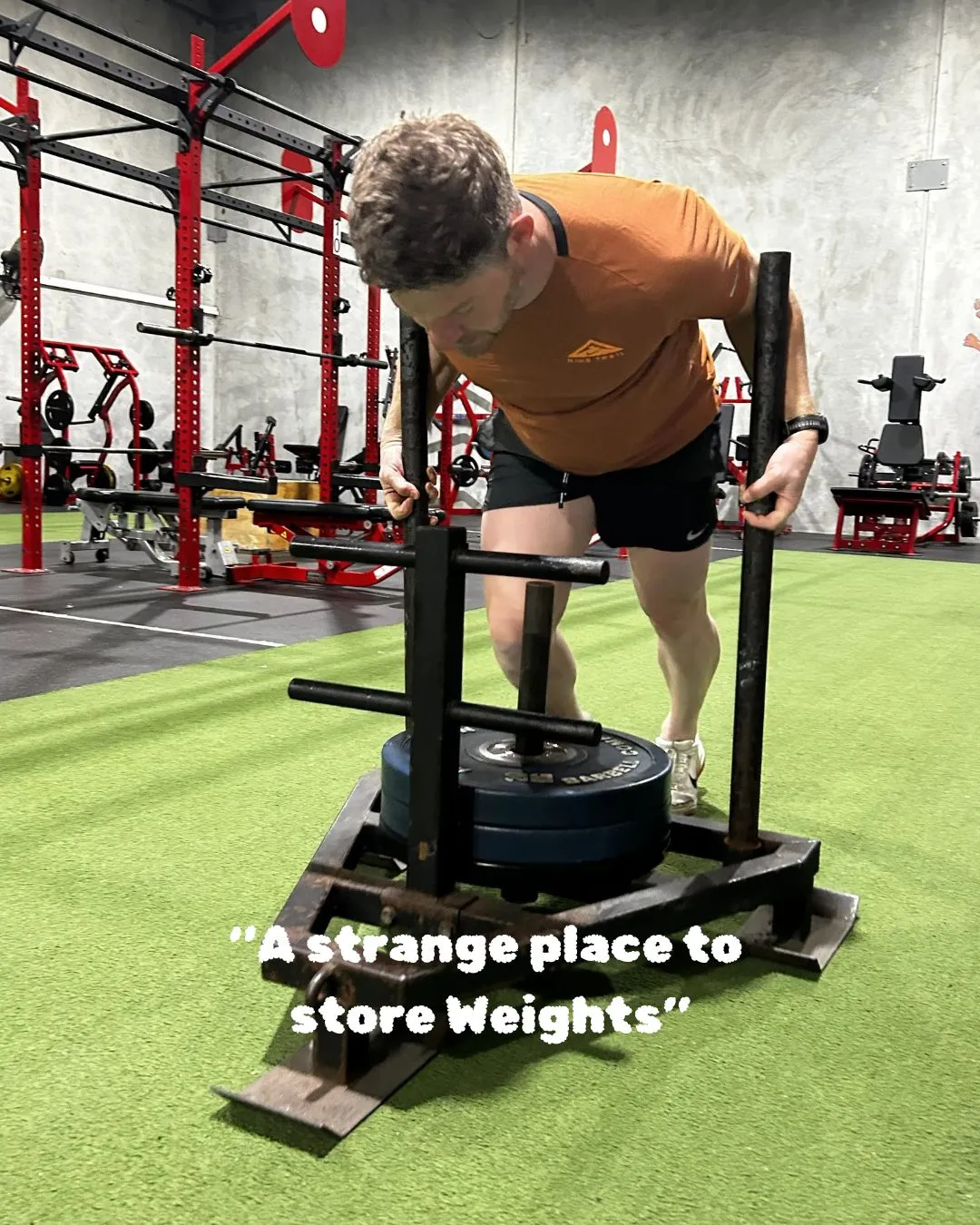
A STRANGE PLACE TO STORE WEIGHTS
I started training at home sometime in the mid-1980s. Calling it a home gym would be generous. I had a set of dumbbells I'd bought from K-Mart. I actually walked to K-Mart to buy them, which seemed like a perfectly reasonable plan right up until the moment I walked out carrying a box filled with weights and realised I also had to walk home.
Let's just say the return journey wasn't quite as smooth — or as quick — as the walk there. Teenage boys are pretty good at having ideas. We're not always great at thinking through the logistics.
Eventually, the dumbbells and I made it home. And the dumbbells themselves were magnificent pieces of 1980s engineering. There were six plates per dumbbell — three on each side — and the plates themselves screwed directly onto the handle. In theory.
In reality, every plate seemed to have formed a lifelong commitment to one particular thread on one particular end of one particular dumbbell. Once you'd figured out which plate belonged where, you really didn't want to mess with the system. Changing weights wasn't exactly something you did between sets.
This was 1980s training reality. Today we get frustrated if there isn't a dedicated power rack available for everyone. Back then I had weight plates sitting right next to the dumbbell and sometimes couldn't actually attach them because the bloody threads didn't match properly.
And I trained anyway.
THE HOME GYM
The dumbbells weren't our only pieces of fitness equipment. We had a chest expander. If you've never seen one, it was basically two handles connected by steel springs. You could add more springs as you got stronger. Three springs locked in place, baby.
We also had a Bullworker. Again, if you don't know what a Bullworker is, find someone who grew up in the '70s or '80s. There's a decent chance they'll know exactly what I'm talking about.
And then there was Mum's exercise bike. The bike had followed what I now realise is the traditional lifecycle of home exercise equipment. Purchased in a moment of inspiration. Used sparingly — if ever. Gradually became somewhere to hang clothes. Eventually relegated outside where it sat, neglected and forgotten.
It was also broken, so I didn't ride it. I lifted it.
This was the 1980s. Everything seemed to be made out of steel, and that exercise bike was bloody heavy. So I curled it — because teenage boy — and I did something vaguely resembling what we'd now call a ground-to-overhead with it.
I can't remember the brand. I couldn't tell you what it weighed. But I can still picture the thing. Cornflower blue.
This was training before I knew anything about training. There was no internet. No YouTube. No Instagram. No training apps. I certainly wasn't wondering whether I had the optimal combination of volume, intensity and frequency. I wanted to get stronger, so I found heavy things and lifted them.
Honestly, it wasn't the worst place to start.
THEN THINGS GOT SERIOUS
As footy became more serious, so did the training. Or at least what passed for serious training in the late 1980s.
We certainly didn't have an “S&C Coach”. I'm not sure anyone playing footy in Perth in the late '80s even knew what an S&C Coach was. But we did have a program. And a barbell.
One barbell.
The program was a series of exercises performed one after another using that same barbell. The objective was pretty straightforward: complete the whole thing three times as fast as possible. Good results went on the wall.
That was pretty much it.
Looking back from 2026, I could probably find about 400 things wrong with that program. But here's the annoying part: it worked. We trained hard. We competed with each other. We got stronger. We got fitter.
And without really knowing it, I started collecting little pieces of information about training. I just didn't know I was collecting them yet.
A STRANGE PLACE TO STORE WEIGHTS
Over the years there were more gyms, more programs, more coaches, more books and a LOT more equipment. Eventually, in 2010, there was Round 1.
And over the past 16 years we've accumulated plenty of stuff. Barbells. Dumbbells. Kettlebells. Boxing bags. Rowers. SkiErgs. Bikes. Sleds. Racks. Wall balls. We've come a long way from trying to work out which bloody plate will screw onto which dumbbell.
But somewhere along the line I realised that Round 1 isn't really a place to store weights.
What we've built is a coaching-based gym.
And inside that gym, what we've really been storing for the past 16 years is experience.
Every session we've ever run has added to it. Not every session has been perfect. Far from it. We've written workouts that looked brilliant on paper and discovered they didn't work particularly well once 20 actual human beings started doing them. We've tried exercises that stayed in our programs for years and others that quietly disappeared after a couple of weeks.
We've changed timings, equipment, class formats and coaching cues. We've watched people get incredibly fit and we've watched people struggle. We've helped people work around injuries, come back from injuries, lose weight, get stronger, prepare for competitions and sometimes simply keep training during periods when everything else in their life was making that difficult.
We've coached people in their 20s, 30s, 40s, 50s, 60s and beyond. And every one of those experiences has taught us something.
IT ALL STACKS
That's the thing about experience. It stacks.
The brilliant class we ran this morning doesn't disappear when everyone goes home. Neither does the terrible one we ran eight years ago. We learned something from both.
A coach finds a better way to explain something, so we keep it. A workout gets completely jammed up because we've put the wrong exercises together, so we remember it. Someone can't perform an exercise and we find a modification that works brilliantly, so we use it again. A program gets great results, so we build on it. Something doesn't work, so we change it.
None of those individual moments seems particularly important at the time. But stack them together for 16 years and you've built something.
And that's something you can't really fast-track.
You can buy better equipment. You can do another course. You can download another program. You can find 10,000 workouts online before breakfast. All of those things can help.
But you can't download thousands of repetitions of “We tried this. This happened. So next time we did this instead.”
You have to earn those. One session at a time.
WHAT WE'VE REALLY BEEN STORING
Sixteen years of running Round 1 certainly hasn't taught me that I know everything about training. If anything, it's taught me how much there still is to learn.
But we're not starting from scratch anymore either. Every time we write a program, coach a class, help someone through a difficult session or change something because it isn't working, we're drawing on everything that came before it.
Sixteen years of classes, mistakes, good ideas, bad ideas and watching real people train.
That's what we've been storing.
The weights are just the things sitting on the racks.
The valuable stuff is the experience we've accumulated around them.
And every day we open the doors, coach another class and try something else, we add a little bit more.
Although after all those years, occasionally I look at what we've programmed and realise we've somehow ended up right back where I started.
Here's the workout. Go fast.
And if you get a good result...
We'll probably put it on the wall.