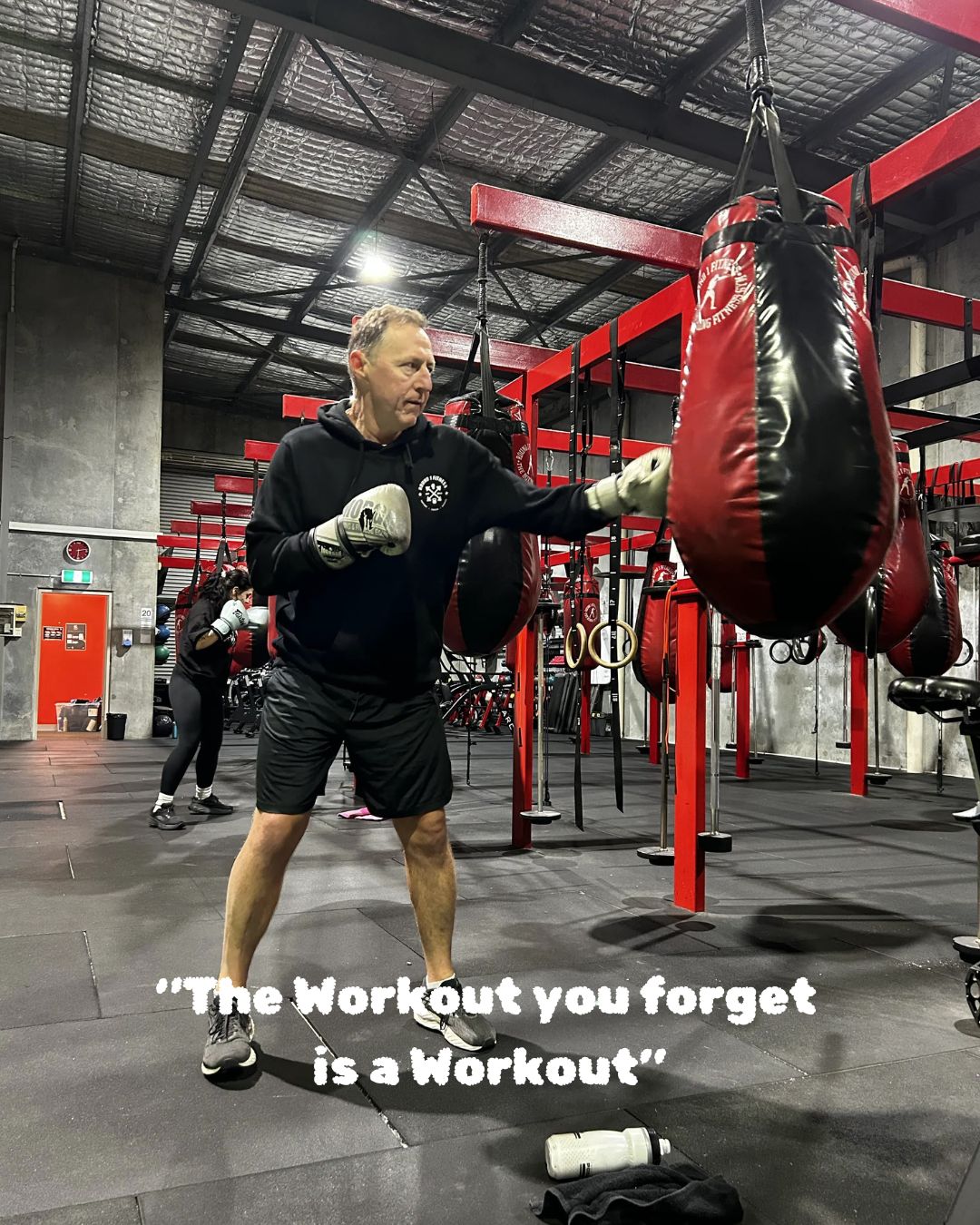
The Workout You Forget Is a Workout
There is something strange that happens to time when you're exercising.
Three minutes can be an incredibly long time.
Get on a treadmill, push the speed up to something uncomfortable and tell yourself you're not allowed to stop for three minutes. Suddenly you're aware of every second. You look at the clock expecting two minutes to have passed and discover you've been running for 37 seconds.
The same thing happens on a bike, rower or SkiErg. When the only objective is to keep working until the clock reaches zero, the clock can become pretty much the only thing you think about.
Boxing is different.
Not easier. Definitely not easier.
Just different.
You can start a three-minute round working on a jab-cross-hook. Then we might add a defensive movement. Now you're trying to remember which direction you're supposed to roll. Then there's another punch coming out of the roll. You mess it up, reset your feet and try again. The coach changes the instruction, you finally get the combination flowing and then...
DING.
Three minutes is gone.
You haven't somehow avoided the exercise. Your heart rate is up, your shoulders are burning and you're breathing hard. You've done the work.
You just weren't thinking about the work the whole time.
I've been thinking about this quite a bit lately because a couple of weeks ago I wrote about the supposed "secret" to boxing fitness. That article (you can read it here: https://round1fitness.com.au/post/The-Secret-to-Boxing-Fitness-Isnt-Really-a-Secret) started with a ridiculous advertisement claiming that old-school boxing trainers had known the secret to getting lean for 100 years and the fitness industry had somehow kept it hidden from everyone.
The claim was nonsense, but there was an interesting idea buried underneath it. Boxing really is very good at getting people to work hard, and I don't think that's simply because boxing rounds happen to resemble interval training.
I think it's because boxing gives the work somewhere to hide.
That's an important distinction.
We tend to talk about making exercise enjoyable as though the solution is to make it easier. Turn the intensity down. Make everything achievable. Remove the uncomfortable bits. Find something that doesn't really feel like exercise.
I'm not sure that's right.
Some of the most enjoyable training sessions I've ever done have also been incredibly hard. I'm sure plenty of people reading this have experienced the same thing. You finish absolutely exhausted, sit down for a couple of minutes trying to get yourself back together and still think, That was awesome.
The difficulty wasn't the problem.
The difference was that you were engaged.
There was something happening beyond simply trying to survive until the workout finished.
That's one of the reasons I've always loved boxing as a training method. There is an enormous difference between doing three minutes of exercise and doing a three-minute boxing round.
In the first example, the objective is often just to keep going.
In the second, you've got a job to do.
You're trying to hit the bag properly. You're thinking about where your hands are coming back to. You're trying to move your feet instead of reaching for the target. You're remembering that after slipping outside the jab you need to come back from that side. You're trying to put some power into the final punch without losing your position.
Meanwhile, your body is doing exactly what we wanted it to do anyway.
You're moving.
You're working.
You're getting tired.
You're recovering.
Then you're doing it again.
And as your boxing improves, the experience changes again.
When someone first starts, a combination like jab-cross-hook can require almost all of their concentration. They have to think about every punch individually. Give them a few weeks and that combination starts becoming automatic, so now we can add movement. Then defence. Then another attack. Eventually they're responding to instructions almost without consciously translating them.
The workout hasn't disappeared.
We've simply given their brain a more interesting problem.
I think there's something in this that applies well beyond boxing.
One of the mistakes we make with exercise is assuming that the best training program is the one that burns the most calories, produces the highest heart rate or leaves us the most exhausted. Those things are easy to measure, so naturally we pay attention to them.
But there's another question that might matter even more:
Did you actually want to do it?
Not every second of it. That's unrealistic. There will always be rounds you don't particularly enjoy and days when training feels harder than it should.
I mean something broader.
Does the activity give you a reason to come back?
Running can do that. You start chasing a distance or a time. Strength training can do it because there's enormous satisfaction in learning a lift and gradually becoming stronger. Sport does it almost automatically because you're playing a game rather than completing a workout.
Boxing does it through skill.
There's always something you can get better at.
A cleaner combination. Better footwork. More power. Better defence. Staying relaxed when you're tired. Maintaining your technique late in a round. Reacting instead of having to think about what comes next.
That's progress that has nothing to do with the number on the scales or how many calories your watch says you burned.
And ironically, while you're concentrating on all of that, you tend to accumulate a fair bit of exercise.
Maybe that's something worth considering when you're trying to find a form of training you'll actually stick with.
We spend a lot of time asking which exercise is the most effective.
Perhaps we should occasionally ask which one is interesting enough that we'll still be doing it six months from now.
Because consistency doesn't always come from finding something easy.
Sometimes it comes from finding something difficult that's worth paying attention to.
And if you're lucky, the bell rings before you've had time to look at the clock.