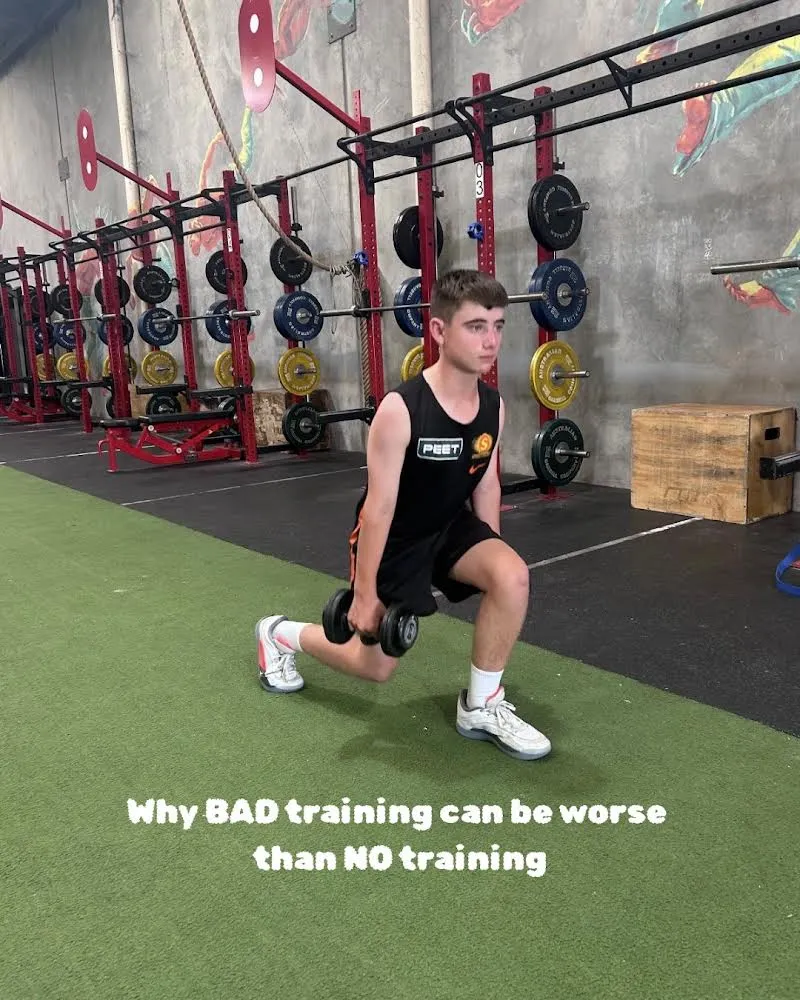
Developing Athletes: Why Bad Training can be worse than NO Training
Why Bad Training Can Be Worse Than No Training
And why the right mix of sport + gym matters for 12–16 year olds
School's back - which means it wont be long until it's time for something so close to my heart! The first night back at footy training for young boys and girls everywhere!
That first session so often starts with good intentions.
New season. Fresh energy. Whistle in hand.
The kids line up… and before anyone’s touched a ball, they’re sent off on a 2km time trial.
It looks organised.
It looks tough.
It looks like “getting a fitness baseline”.
But there’s a simple question that rarely gets asked:
When have you ever seen a footballer run 2 kilometres non-stop during a game? Let alone a junior player?
Footy is built on:
Short accelerations
Hard decelerations
Changes of direction
Contests, collisions, stoppages
Repeated efforts under fatigue
It’s chaotic and reactive — not a steady jog around an oval.
So when we ask a 13-year-old, fresh off an off-season, to run 2km continuously, what are we actually testing?
Not game fitness.
Not skill.
Not decision-making.
And certainly not how well they move.
What we’re really measuring is discomfort tolerance — while exposing poor movement patterns under fatigue.
For some kids, that’s manageable.
For others, it’s demoralising, painful, or both.
And while it feels like preparation, it often creates more problems than it solves. So...why are we doing it?
This isn’t about blaming coaches
Most junior coaches care deeply (and I don't want to be criticising people volunteering to help coach kids!). Most parents are simply trying to support their kids.
The issue isn’t effort or intent — it’s how young athletes are being prepared.
Junior sport often borrows from adult training:
Fitness tests instead of preparation
Conditioning instead of movement quality
“Hard work” instead of smart work
It feels familiar because many adults grew up with it.
But familiar doesn’t always mean appropriate — especially between 12 and 16, when bodies are changing rapidly.
Why this age is different
Between 12–16, athletes are:
Growing fast
Changing limb lengths and coordination
Relearning how to control their bodies
Highly sensitive to fatigue and overload
At this age, training doesn’t just build fitness.
It teaches the body how to move under pressure.
That’s why the quality of training matters more than the quantity.
When training misses the mark
Bad training at this age doesn’t always look bad.
Often it just looks hard.
But the hidden costs add up.
1. Poor movement becomes the default
When young athletes repeatedly move poorly — especially when tired — those patterns stick.
Later on, coaches aren’t improving performance.
They’re undoing habits.
2. Bodies get overloaded before they’re ready
Bones, tendons and joints adapt slower than motivation.
That’s where:
Knee pain
Heel pain
Back tightness
Constant “niggles”
Start appearing and get dismissed as “just growing pains”.
3. Confidence quietly erodes
Not every athlete fails loudly.
Some just:
Feel clumsy
Feel slow
Feel behind
They don’t think “this training isn’t right for me”.
They think “maybe I’m not good at this”.
That’s often where dropout begins.
When development squads quietly double the load
This is where things really escalate.
A young athlete is invited into a development-level program.
It’s exciting — and it should be.
Better coaching.
Higher standards.
Training alongside stronger, faster peers.
But almost overnight, the training week shifts from:
2x club sessions
to2x club + 2x development sessions
That’s a 100% increase in training load.
On paper, it looks like progress.
In reality, it often creates problems.
More sessions don’t automatically mean better development
It’s easy to assume:
“If the coaching is better, more of it must be better.”
But development doesn’t work like that.
Without changes to:
Session intent
Intensity and volume
Recovery and rest
The type of work being done
Four sessions often become:
Four lots of running
Four lots of fatigue
Four similar sessions
Four chances to reinforce poor movement while tired
That’s not development.
That’s accumulation.
Where things start to unravel
The warning signs are subtle at first:
Kids are always sore
Energy drops late in the week
Speed disappears
Posture collapses under fatigue
Then come the bigger issues:
Ongoing “growing pains”
Repeated minor injuries
Confidence loss
Performance plateaus
Parents are left wondering why more opportunity isn’t leading to better outcomes.
The missing question parents rarely get to ask
The real question isn’t:
“How many sessions are they doing?”
It’s:
“What problem are the extra sessions actually solving?”
If all sessions look the same, the athlete isn’t getting:
Better movement
Better strength
Better speed mechanics
They’re just getting more tired.
What the right mix actually looks like
The best outcomes usually come from balance.
✔ A couple of nights at sport
Where kids:
Learn skills
Play
Compete
Enjoy being part of a team
✔ A couple of nights in the gym
Where they:
Learn how to move properly
Build strength relative to their body
Develop speed — acceleration and deceleration
Learn to maintain posture under fatigue
Add load only when technique allows
The gym doesn’t replace sport.
It supports it.
Why we run Developing Athlete sessions
Our Developing Athlete sessions aren’t about turning kids into weightlifters.
They’re about:
Teaching movement first
Using strength training to improve control and resilience
Building speed and braking ability
Challenging posture under pressure
Managing load through growth phases
By separating physical development from sport training, athletes:
Get more out of their sport sessions
Break down less
Recover better
And build confidence in their bodies
That’s the goal.
A better question for parents to ask
Instead of:
“Is this hard enough?”
“Will this make them fitter?”
Try:
“Is this appropriate for their age and stage?”
“Is this building something we’ll rely on later?”
“Would we be happy doing this for the next 12 months?”
That last question matters.
Playing the long game
The goal isn’t a strong 14-year-old.
It’s an 18–22-year-old who:
Is healthy
Moves well
Has confidence in their body
Still enjoys training and sport
Sometimes progress doesn’t come from doing more.
It comes from doing the right things, at the right time, for the right reasons.
If you’re unsure whether your child’s current training mix is supporting long-term development — or just adding fatigue — a short conversation can often bring clarity. Getting this stage right makes everything that comes after much easier.