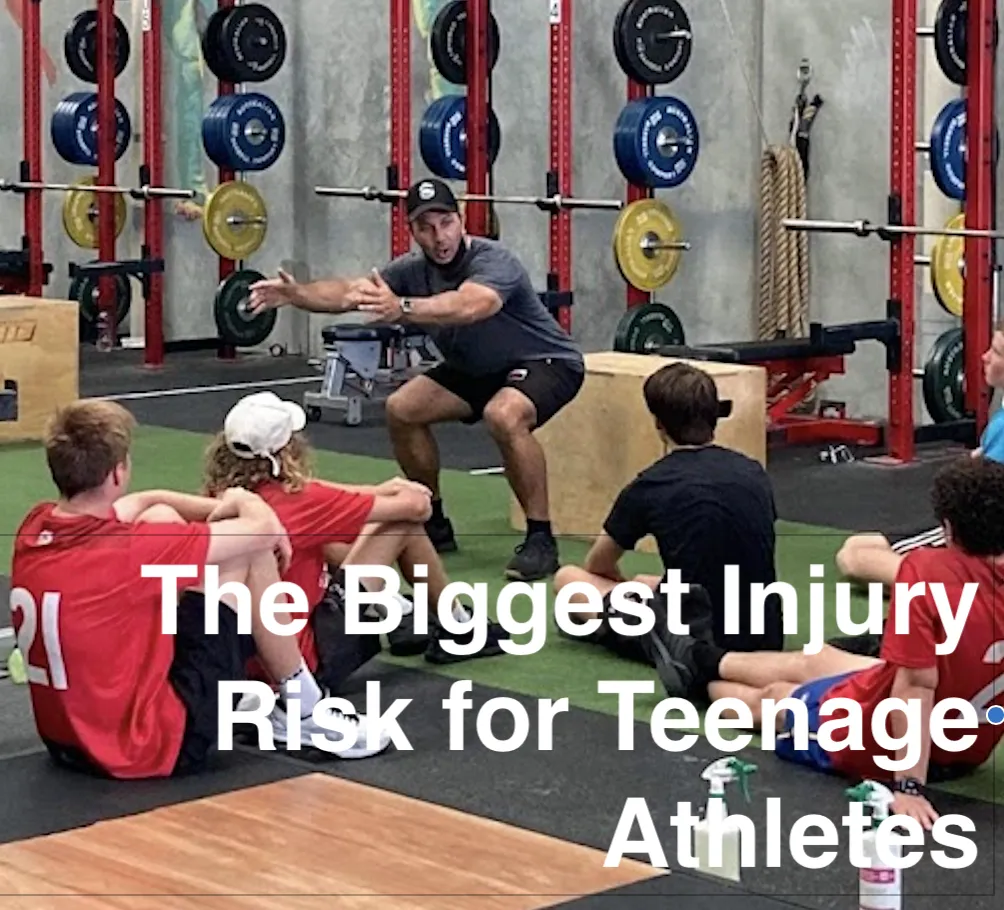
January 15th: The Biggest Injury Risk for Young Athletes
Why We Don’t Copy Adult Training Programs for Teenagers
When young athletes get injured, it’s easy to blame bad luck.
A collision.
A bad landing.
One moment that went wrong.
But in my experience, the biggest injury risk for teenage athletes isn’t contact, or effort, or even playing too much sport.
It’s training that doesn’t match their stage of development.
Teenagers don’t get hurt because they train hard.
They get hurt because they train like adults before their bodies are ready.
That difference matters more than most people realise.
Teenage bodies aren’t “small adult bodies”
Teenage athletes are changing systems — not just growing in size.
Bones lengthen quickly.
Muscles adapt fast.
Tendons and connective tissue lag behind.
Coordination can dip during growth spurts.
Recovery capacity fluctuates week to week.
This creates a mismatch where:
Strength can increase faster than tissues can tolerate
Speed improves before movement quality fully stabilises
Fatigue shows up in subtle ways before it becomes obvious pain
None of this is a problem on its own.
It becomes a problem when training loads assume a finished system.
Adult programs assume stability — teenagers don’t have it yet
Most adult training programs are built on a few quiet assumptions:
Joints are stable
Movement patterns are ingrained
Recovery is predictable
The athlete has years of exposure to load
Teenagers don’t tick those boxes yet.
So when a 14–17 year old starts:
Copying bodybuilding splits (I mean, why not follow the 'Wolverine Workout'?)
Following high-volume conditioning programs
Lifting heavy under fatigue week after week
Chasing numbers instead of capacity
The risk doesn’t show up immediately.
It builds.
The injuries we actually see aren’t dramatic
Most teenage injuries don’t come from one big moment.
They come from patterns.
Knees that are “just sore” every session
Hamstrings that are always tight
Lower backs that feel stiff after training
Shoulders that quietly limit skill work
These aren’t freak accidents.
They’re load-management injuries.
The body is doing its best to cope — until it can’t.
“More training” isn’t the same as “better preparation”
This is where it gets tricky, especially for motivated families.
Many young athletes are now juggling:
Team training
Extra skills sessions
(Mostly unsupervised) Gym sessions
Private coaching
Individually, none of these are bad ideas.
The issue is that they often stack the same stress over and over:
High speed
High fatigue
High intensity
Minimal recovery
Effort isn’t the enemy.
Poor coordination of stress is.
What teenage training should actually prioritise
Good youth training isn’t about holding kids back.
It’s about building capacity that lasts.
At this stage, training should emphasise:
Movement quality before load
Strength as tissue capacity, not max lifts
Exposure over exhaustion
Consistency over intensity spikes
A great teenage session doesn’t leave athletes destroyed.
It leaves them better prepared for tomorrow.
The real goal is simple:
Build athletes who are still training — not rehabbing — at 18, 20, and beyond.
Why we deliberately don’t copy adult programs
This is intentional.
Adult programs chase performance outputs.
Teen programs must protect availability.
Availability means:
Being able to train
Being able to play
Being able to improve week to week
An athlete who is “fit but injured” isn’t developing.
They’re surviving.
The most talented athletes I’ve coached weren’t the ones who did the most at 15 —
they were the ones still progressing at 22.
The long game matters
Teenage years are not the finish line.
They’re the foundation.
Strength training, conditioning, and gym work are incredibly powerful tools — when applied correctly.
Done well, they reduce injury risk, build confidence, and support performance.
Done poorly, they quietly limit potential.
Our job isn’t to rush teenagers into adult systems.
It’s to prepare them for them.
And that takes patience, structure, and experience.
Not sure if your athlete’s training actually makes sense?
If your child is training hard but dealing with constant soreness, recurring niggles, or confusion about how gym work should fit around sport, it’s worth stepping back and looking at the big picture.
A proper consultation allows us to:
Understand what sport they’re playing and what their week actually looks like
Check whether their current training load matches their age and stage of development
Put a simple, sustainable structure in place that supports performance and long-term health
If you’d like help building a plan that keeps your athlete training, improving, and available, you can book a free consultation below.
👉 Book a Free Athlete Consultation
https://round1fitness.com.au/free-consultation/