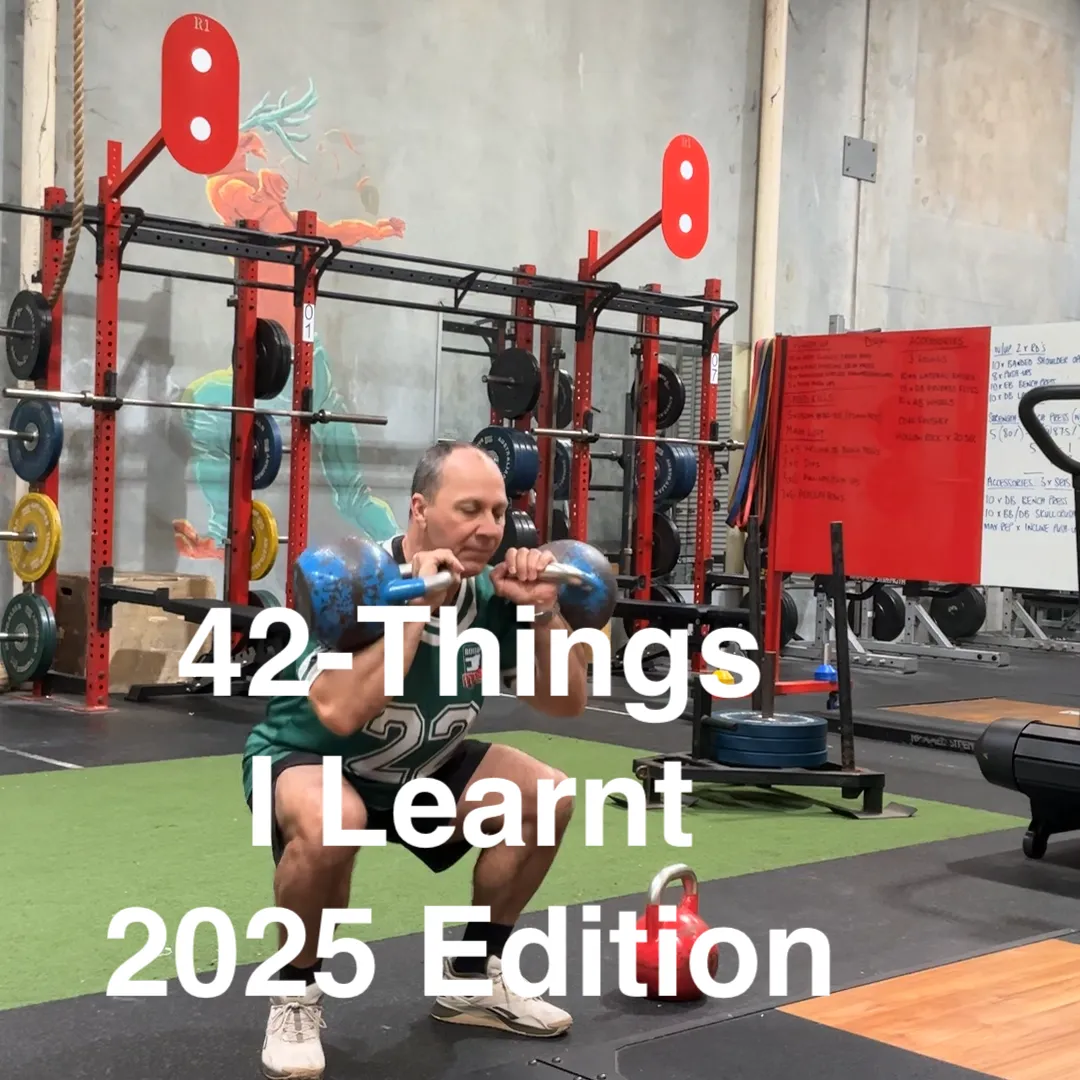
42-Things-I-Learned, 2025 Edition
42 Things I Have Learned (2025 Edition)
By Mick / Round 1 Fitness
Since opening the gym in 2010, I’ve (I think?) now written eight different “42 Things I Have Learned” posts at the end of each year.
I started writing these as a blatant rip-off of the Power Athlete site where John Welbourn had posted his own list… and look, when you’re trying to write a blog every week, you steal every idea you can!
As each year passes, I feel like I keep learning (I also keep forgetting), but it’s always fun to reflect on the things that popped up—or popped BACK up—over the last 12 months.
I’ve got most of the old blogs saved somewhere from the old website. Maybe I’ll get a chance over the December “break” (lol) to re-post them so the archive lives again. But anyway, it’s 2025, so here we go:
Enjoy the follow-up with another 42 Things I Have Learned.
1. Prepping your breakfast and lunch every day is the ‘secret’.
I know this is dumb because I’ve had the gym for 15 years now, but I truly believe the number one thing holding most people back is their nutritional habits. MAKE your lunches—don’t rely on leftovers (once or twice a week there simply won’t be any). And replace your breakfast with 200–400g of Greek yoghurt and a scoop of protein powder. It sounds too simple to matter, but it matters.
2. Everyone has a different idea of what being “FIT” or “In-Shape” looks like.
For the most part though, forget the final image. Just imagine doing three structured fitness sessions per week, walking 8,000+ steps every day, and going to bed at a time that gets you at least 6.5 hours of sleep. If you do all of those things, you’re going to be OK.
3. Some people need BIG goals—Ironman, Rottnest, whatever. Most of us don’t.
But having little things 3–4 times per year that are “a bit” out of the ordinary really does help.
Shameless plug: things like Fight Club and Summer Slam at Round 1.
They push you out of your comfort zone just enough that you remember, “Oh yeah, I can do hard things.”
4. Getting old is a lot of things — but it doesn’t have to be an excuse.
The older you get, the harder it becomes to start something new (or start something AGAIN). If you decide to STOP running, or STOP squatting, or STOP whatever… it gets harder to restart as the years go by.
But if you just keep doing them—even at a reduced level—your body will keep supporting you. Stopping entirely is the real problem.
5. If you’re too worried about ‘not eating the same thing’ every day, meal prep will never work.
At the same time, variety in meats, veggies and fruit is important for micronutrients.
Just remember: you need variety, but variety does NOT mean you can’t eat the same breakfast 9 days out of 10. If sameness helps you stay on track… lean into it.
6. If you play, you WILL eventually pay with soreness or injury.
This isn’t negative—it’s just reality. The solution isn’t to stop (go back to point 4).
Knee too sore to lunge? Great. Time to get jacked upstairs for a while.
The best athletes in the world compete with something hurting every week. They don’t quit—they adjust.
7. Sometimes you need to take a half-step back so you can take actual steps forward.
If you’re only doing half-squats, half-pushups, half-whatevers, you’re only getting half the benefit.
Slow down, move properly, rebuild the habit, go again.
It’s amazing how many frustrations disappear when you stop rushing.
8. Gear matters — both for performance AND confidence.
If your shoes hurt, you won’t run. If your gloves are falling apart, you won’t punch. And if your clothes make you feel uncomfortable or like you don’t ‘fit’, that becomes another reason for “no.”
It’s OK to spend money on gear that works AND makes you feel good walking into the gym. That stuff matters more than people admit.
9. Motivation is wildly overrated. Systems are everything.
If you rely on motivation, you’ll train when the stars align and the coffee hits just right.
If you rely on systems—same session days, same packing routine, same food—you’ll train even when life is a bit sideways.
Motivation is weather. Systems are climate.
10. Consistency comes from removing friction, not from pushing harder.
Most people think “consistency” means “discipline.”
But really, consistency comes from making things easy enough that you don’t need discipline every day.
If the routine works, the results take care of themselves.
11. Momentum is fragile — but once you’ve got it, it’s magic.
Missing one session? No big deal.
Missing two or three? Suddenly everything feels heavy again.
Momentum doesn’t need perfection, but it does need protecting.
One session can flip the whole week.
12. Recovery isn’t optional — unless you like being tired, sore, and cranky.
When I was younger, I thought rest days were for the weak. Turns out they’re actually for the smart. (No wonder I never got it!). Sleep, walking, eating properly, actually chilling out for five minutes… these things matter more as the years tick over.
You don’t get fitter during the workout — you get fitter recovering from the workout.
13. Doing “a little bit” forever beats doing “everything” for six weeks.
We all love a good six-week hero run — perfect training, perfect eating, perfect everything.
But the people who actually change their bodies and minds are the “two to three times per week, every week of the year” crew.
Boring wins. No one wants to hear that, but it’s true.
14. People rarely stop training because they’re lazy — they stop because they’re overwhelmed.
Life gets messy. Work piles up. Kids get sick. Sleep gets weird.
Suddenly the gym session that felt easy last month feels impossible now.
You don’t need more motivation — you need to lower the load on your week so you’ve actually got the bandwidth. Again - just find time for two per week - then when you get settled, move to three.
15. In the gym, your training age matters more than your real age.
A 50-year-old who’s been lifting for 20 years is “younger” in TRAINING age than a 30-year-old who’s done nothing.
Experience builds resilience.
Give yourself grace if you’re new. Use your experience if you’re not.
16. Strength training quietly fixes a LOT of problems.
Back stiffness? Weak glutes and hammies.
Feeling fragile? Lift weights.
Being strong improves everything — mood, posture, confidence, sleep.
Strength feels like armour.
17. Cardio works best when you don’t hate it.
It doesn’t have to be a 10km run.
Boxing, ski-erg, rowing, sleds, bikes — if it gets your heart rate up without making you question your life choices, it counts.
The best cardio is the one you’ll repeat.
18. Soreness is not the measure of a good workout.
“OMG I can’t sit down” is not the goal.
Soreness usually just means “I did something different,” not “I improved.”
Progress comes from quality and consistency, not pain.
19. Fat loss without protecting muscle is a one-way ticket to looking worse.
If you starve yourself, the scale absolutely goes down — but you don’t like what you see.
Preserving muscle is everything.
Strong and fuelled > Skinny and struggling.
20. Community is the cheat code.
Training alone is hard.
Training with people who show up, sweat, and occasionally suffer with you?
Different story.
Community makes effort feel normal.
21. The best training program is the one you can stick to.
If you can’t follow it consistently, it’s not perfect — it’s pointless.
Simple plans win. Every time.
22. You don’t rise to your goals — you fall to your habits.
Motivation feels good.
Habits get things done.
Your life reflects what you DO daily, not what you INTEND to do.
23. Managing stress is just as important as managing calories.
High stress ruins sleep, appetite, consistency, decision-making — everything.
You can’t out-train being overwhelmed.
Sometimes the answer isn’t adding more.
It’s taking something away.
24. Walking is still the most underrated fitness tool on earth.
It’s free. It fixes everything.
Walk more. The end.
25. We never really “master” movements — we just become more confident beginners.
Even the basics take a lifetime to refine.
Stay curious, not complacent.
You’ll move better at 60 if you keep learning at 40.
26. Testing keeps you honest — and keeps you progressing.
If you never test, you train in circles.
No numbers = no direction.
Benchmarks matter.
27. A bad week won’t break you — but quitting will.
Two sessions a week might not be your plan, but it beats zero.
There’s only one way to make sure you never get there: stopping.
Keep the thread alive, even if it’s thin.
28. You’re never truly “back to zero,” even if your brain tells you that you are.
A lot of people stay away because they’re embarrassed they aren’t as fit as they “used to be.”
Here’s the truth: no one cares — in the best possible way.
People are just happy to see you.
Your body remembers, your confidence comes back, and the hardest part is walking back in.
29. Waiting for life to ‘calm down’ is the world’s biggest trap.
Life doesn’t calm down.
If your training relies on perfect conditions, you’ll train five times a year.
Build routines that survive chaos.
30. Training should ADD to your life, not compete with it.
Good training helps you parent better, work better, sleep better, feel better.
If it’s draining you more than it’s helping you, something needs to change.
31. People don’t fall off because training is hard — they fall off because life gets loud.
It’s never the burpees.
It’s the 400 life-things happening around the burpees.
Build anchors that hold when life gets noisy.
32. There is always time for what is important — you just have to step back far enough to see it.
When you’re too close to the chaos, everything feels urgent.
Take two steps back — pockets of time appear.
The problem isn’t hours.
It’s clutter.
33. You get better at whatever you repeat — including excuses.
Skip enough sessions - you become someone who skips sessions.
Show up to enough sessions - you become someone who shows up.
Identity is repetition. Your actions are your identity.
34. Strength builds confidence faster than aesthetics ever will.
Lifting a weight you didn’t think you could changes how you feel about yourself.
Strong feels like “I can handle things.”
Capability >>> appearance.
35. The simplest plan is usually the most effective.
People love complicated solutions. I feel like I talk to people every week who are trying some new 'plan' that vanishes knee pain/gets the best results for over 40s/targets fat but only between your toes.
The fundamentals are proven and that is where the magic lies: lift, walk, sleep, repeat.
You don't need to spend hours researching the 'latest' - just stick with what's simple - SIMPLE WORKS.
36. The scale (and the body scanner) are tools — not emotional judges.
They tell you something, not everything.
Treat them like dashboard lights, not court verdicts.
Data is useful. Shame is useless.
37. You can train through a lot — you just can’t train through denial.
Most aches can be trained around.
But ignoring them entirely?
That’s how little problems become big ones.
Be honest. Adjust. Keep going.
38. Fundamentals aren’t for beginners — they’re for the best athletes in the room.
Elite athletes warm up longer and drill basics harder than beginners ever do.
Beginners rush the fundamentals.
Experts revisit them forever.
That’s why experts keep improving.
39. Curiosity beats frustration every single time.
When progress stalls, ask “What’s happening?” rather than “Why am I hopeless?”
Curiosity opens doors.
Judgment slams them shut.
40. Most people are closer to success than they think.
Progress is quiet until it isn’t.
Your body keeps score even when your brain doesn’t notice.
Small things compound.
41. Getting back into shape isn’t punishment — it’s permission.
Permission to rebuild.
Permission to feel good again.
Permission to be someone who shows up.
Identity returns faster than fitness does.
42. The real goal isn’t to look fit — it’s to still be training in 10, 20, 30 years.
Longevity changes everything: how you lift, recover, eat, rest, and talk to yourself.
It’s not about peak moments — it’s about staying available to your own life.
If you can still train, you can still live well.
Lastly...
Well, that’s another 42 Things I’ve Learned… which probably means another 42 things I’ll forget and have to relearn next year.
But honestly, that’s half the fun.
None of us are finished products — we’re all just trying to get a bit better, a bit healthier, a bit more consistent, and a bit less chaotic.
If any of these 42 points hit home, great.
If they didn’t, no worries — life will eventually teach you the lesson anyway, usually with worse timing and more swearing.
Thanks to everyone who trained with me, coached beside me, challenged me, encouraged me, or just kept showing up even when the year felt loud.
Round 1 has never been the building — it’s the people inside it.
See you in 2026.
I’ll be the guy meal-prepping yoghurt again.