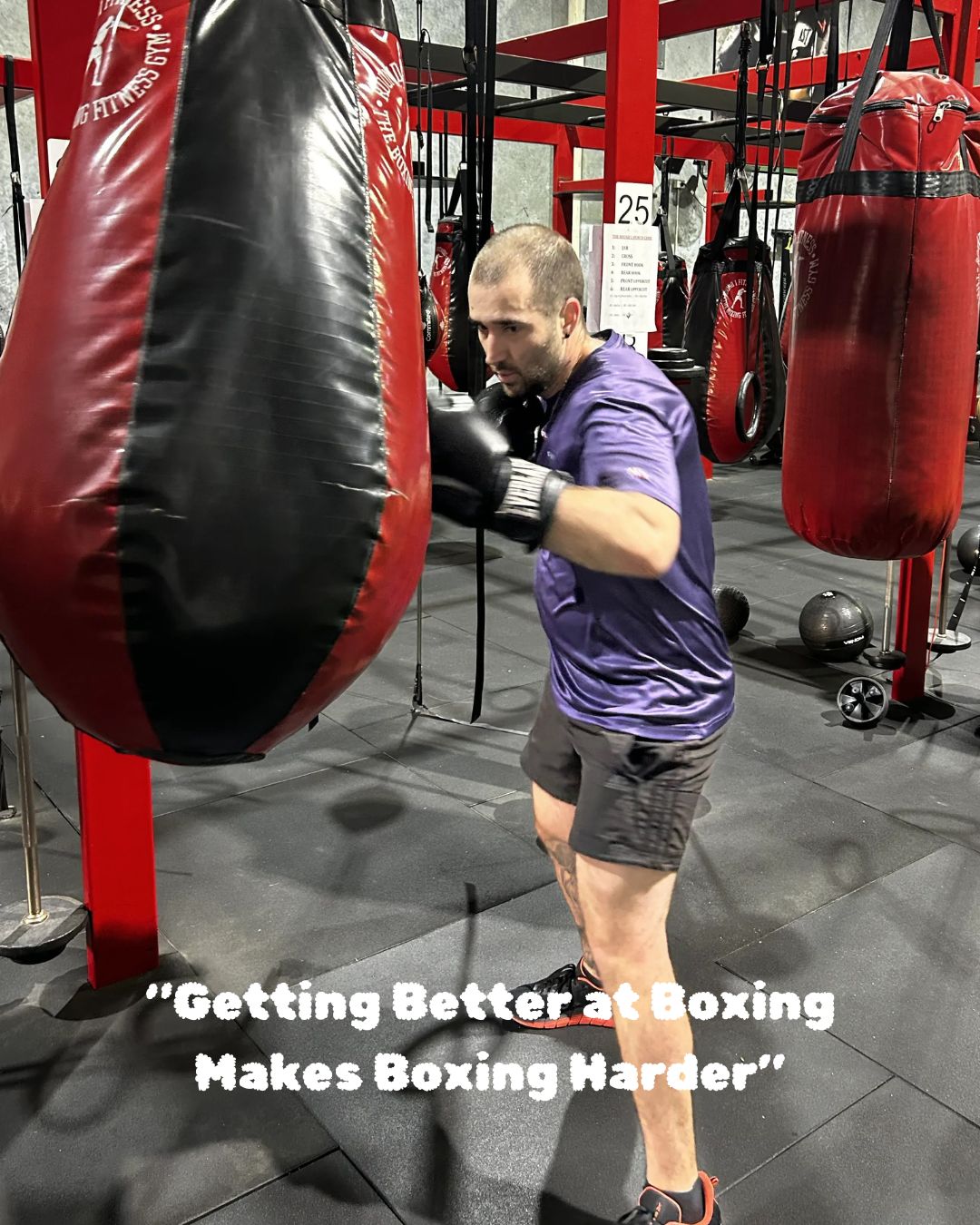
Getting Better at Boxing Makes Boxing Harder
One of the funny things about boxing is that the better you get at it, the harder the workout can become.
That sounds backwards.
Usually when you get better at something, it gets easier. And technically, that's true with boxing as well. A jab-cross-hook that once required your full concentration eventually becomes something you can throw without really thinking about it.
But here's what I've noticed after a lot of years standing in front of boxing classes at Round 1.
When someone first starts, there is a LOT of thinking going on.
We call jab-cross-hook and you can almost see the conversation happening inside their head.
Jab...cross...which one's the hook again?
Then we add a roll.
Everything stops.
Which way am I rolling? What hand do I come back with? Why is everyone else moving already? Hang on...can you show me that again?
And that's completely fine. That's learning.
But all of that thinking creates little breaks in the round.
You throw the combination. Stop. Reset. Think. Go again.
Sometimes the bell rings and you've spent almost as much time trying to work out what we're asking you to do as you've spent actually doing it.
You're still working hard. In fact, beginners often finish completely cooked because they're tense, they're trying incredibly hard and nothing feels natural yet.
But then something changes.
You come to a few more classes.
The jab-cross-hook isn't a problem anymore. The hands just go.
We add the roll and instead of stopping to think about it, you roll and come straight back with the next punch.
Then the coach calls a change.
You hear it.
You do it.
No conference required.
And all of those little gaps that used to exist in the round start disappearing.
That's when boxing gets harder.
Because now instead of:
Punch. Punch. Punch. Stop.
You're boxing.
You're throwing the combination, moving off, coming back in, defending, countering, resetting your feet and going again.
Same bag.
Same three minutes.
Completely different workout.
We see this all the time in BoxPlus.
Two people can stand beside each other doing exactly the same round and have two completely different experiences.
Someone newer might be concentrating on getting the punches in the right order. That's their job for the round. Someone who's been doing it for a couple of years might be throwing the same combination harder, adding better movement, getting straight back to work after the defensive movement and barely giving themselves a second to breathe.
Neither person is doing the round "wrong".
They're just at different points.
And that's one of the things I really like about boxing.
We don't necessarily need to make the exercise more complicated as you get fitter.
We don't need to decide that you've been punching a bag for six months, so now apparently you need to punch the bag while standing on one leg holding a kettlebell because PROGRESSION.
You can just get better at boxing.
Better technique means you can hit harder.
Better coordination means you can put combinations together faster.
Better footwork means you spend less time standing there trying to get yourself organised.
Better fitness means you recover quicker and can get back to work.
Better understanding means when the coach calls something, you react rather than spending five seconds trying to translate what you've just heard.
Bit by bit, the dead time disappears.
And suddenly those three-minute rounds contain a hell of a lot more boxing than they used to.
I think that's an important part of progression that we sometimes miss in fitness.
We're used to progression being something we can write down.
Last week you squatted 80kg. This week you squatted 82.5kg.
Last month you ran 5km in 27 minutes. This month you ran it in 26.
Those things are easy to see.
Boxing progress can be a bit quieter.
Maybe three months ago a roll completely stopped you in your tracks. Now you don't even think about it.
Maybe you used to throw the combination and then stand there waiting for the next call. Now you're moving your feet and getting yourself back into position.
Maybe the final round used to turn into survival mode. Now you're still actually boxing when the last bell goes.
Nobody puts those numbers on a leaderboard.
But they're improvements.
And here's the good bit.
Every one of those improvements gives you the capacity to do more work.
That's why I don't particularly worry about people getting "too fit" for our boxing classes.
If the round feels easy, there's almost always somewhere to go.
Move more.
Punch more.
Hit harder.
Recover into position quicker.
Make the defence cleaner.
Get back onto the attack sooner.
Or—and this one catches plenty of people—try doing all of that while actually keeping your hands up.
There's always something.
But there's an important flip side to this.
If you're new, don't rush it.
You don't need to look at the person on the bag beside you who's been boxing at Round 1 for five years and try to match what they're doing.
If you need to stop and work out the combination, stop and work it out.
If you need to slow the punches down to get them right, slow them down.
If the coach calls something and your brain temporarily leaves the building, welcome to boxing. We've all been there.
The goal isn't to absolutely destroy yourself in every round.
The goal is to keep learning.
Because eventually you won't need that little pause.
Then you won't need the next one.
Then one day the bell will go and you'll realise you've just spent three minutes punching, moving, defending and attacking without really stopping.
Congratulations.
You've become better at boxing.
Unfortunately, you've also just made your workout harder.
Funny how that works.